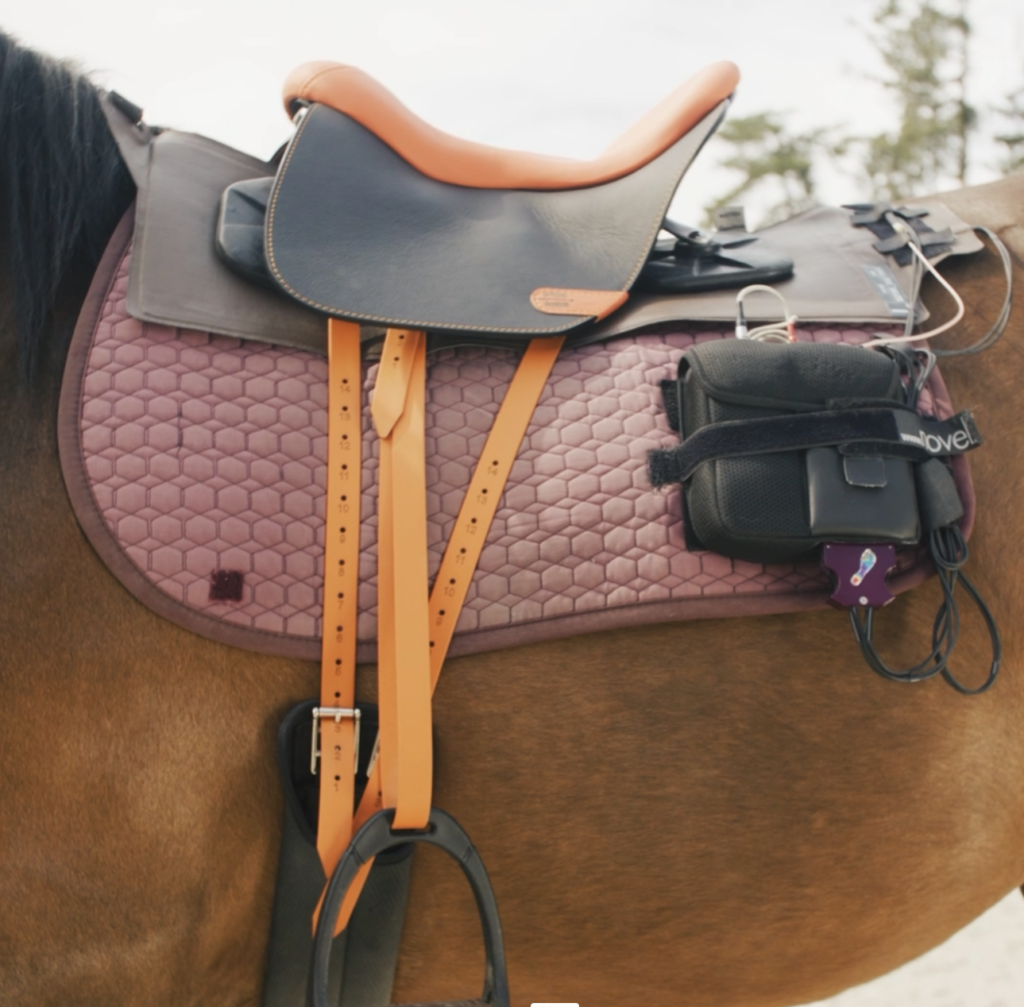
The search for a saddle that respects the horse’s movement must also be supported by objective data. For this reason, the Spiritnova configuration was subjected to a dynamic pressure measurement session and compared with a traditional saddle used as a reference.
The objective was not to identify a “perfect saddle,” but to observe how different design approaches influence the distribution of forces on the horse’s back during movement.
Key Findings
The measurements highlighted three particularly noteworthy aspects.
+48% Larger Load-Bearing Surface
The tested Spiritnova configuration demonstrated a significantly larger contact area compared with the traditional reference saddle.
A larger load-bearing surface allows the load to be distributed over a greater area of the horse’s back, helping to prevent forces from becoming concentrated in limited zones.
-48% Peak Pressure
One of the most significant findings concerns peak pressure values, which were found to be nearly half those recorded with the traditional saddle used in the comparison.
Reducing areas of high pressure is particularly important, as it indicates a more even distribution of the forces generated during work and movement.
-32% Average Pressure
The average pressure recorded throughout the testing session was also lower than that measured with the comparison configuration.
This suggests a more balanced management of load during movement and a reduced concentration of forces in the areas subjected to the greatest stress.
An Overview of the Results
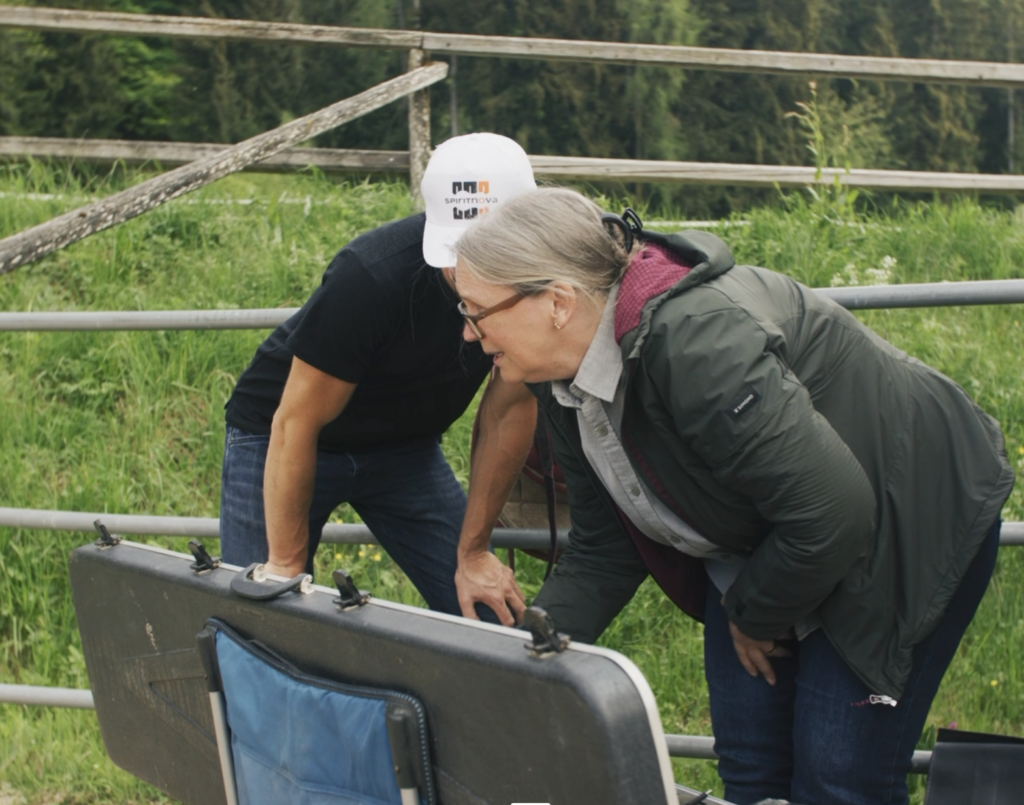
In addition to individual measurements, the analysis system generated an overall summary of the data collected during the testing session.
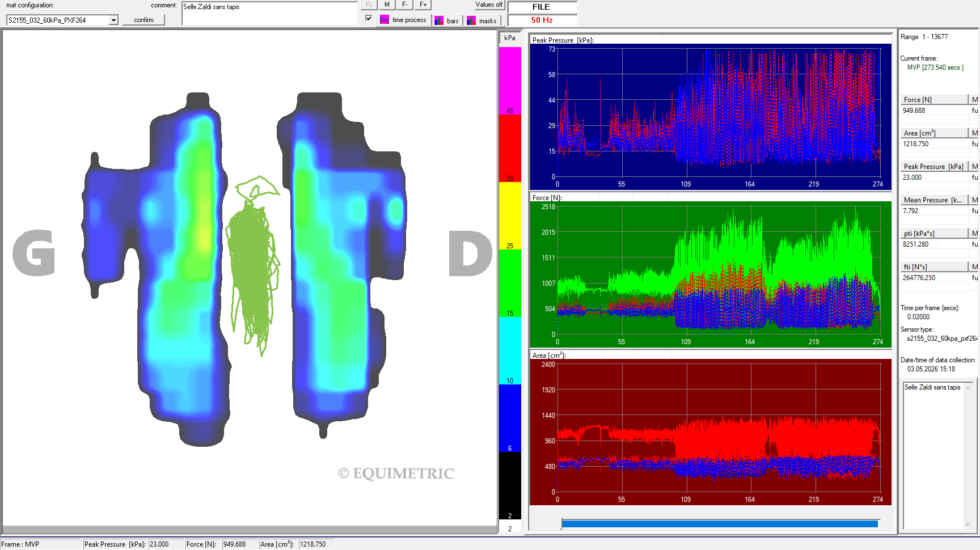
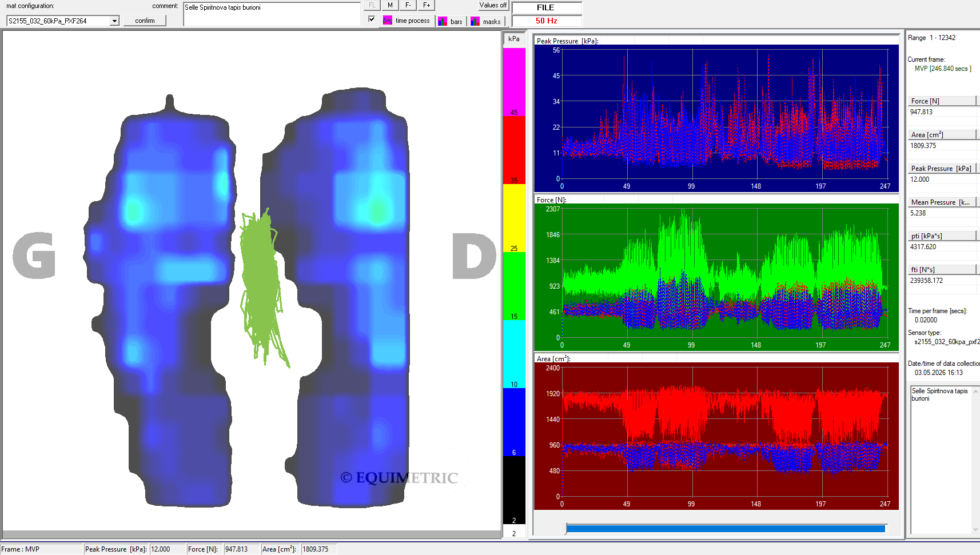
The following images show a summary of the measurements obtained from the two configurations analyzed. Even at first glance, a different pressure distribution on the horse’s back can be observed, with a larger contact surface and lower pressure values in the tested Spiritnova configuration.
These summary analyses make it possible to evaluate not only a single moment of movement, but also the overall behavior of the saddle throughout the work session.
TRADITIONAL ENGLISH SADDLE
SPIRITNOVA PRIMA
Beyond the Numbers
The analysis also highlighted good saddle stability during work and a more homogeneous distribution of pressure across the different support areas.
According to the observations reported in the study, the analyzed Spiritnova configuration demonstrated:
- A large load-bearing surface;
- Less concentrated pressure distribution;
- Good dynamic stability;
- Uniform distribution of forces across the horse’s back.
A Comparison During the Same Phase of the Canter
The image below shows one of the measurements recorded during the test.
The image illustrates the pressure distribution recorded by the sensor mat at a specific moment of the gait cycle, with horse and rider analyzed during the same phase of the canter. The tested Spiritnova configuration is shown on the left, while the traditional saddle used as a reference is shown on the right.
The different colors represent the intensity of the pressures exerted on the horse’s back: warmer areas indicate higher pressure values, while cooler areas indicate a more even distribution of load.
The image provides a visual representation of the numerical findings, highlighting a larger contact surface and a lower concentration of pressure in the analyzed Spiritnova configuration.
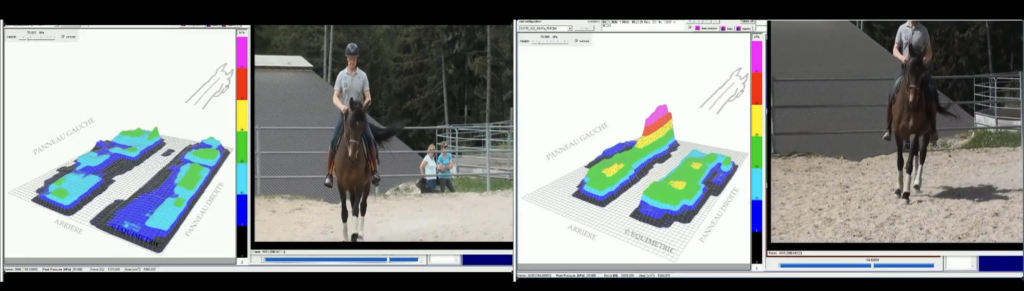
Comparison of pressure maps during the same phase of the canter. On the left, the Spiritnova saddle; on the right, the traditional English saddle used as the reference in the test. Measurements were synchronized at the exact same moment of the gait cycle to allow a direct comparison of pressure distribution on the horse’s back during movement.
Comparison During the Same Phase of the Trot
In addition to the overall analysis of the testing session, a direct comparison was carried out during the same phase of the trot.
The following image shows the pressure maps recorded at the exact same moment of the gait cycle, allowing a consistent comparison between the two saddle configurations analyzed. Synchronizing the phase of movement eliminates variations caused by the horse’s natural oscillation and makes it possible to observe exclusively how each saddle distributes pressure across the horse’s back.
The analysis reveals a broader distribution of pressure across the bearing surface and a lower concentration of loads in the areas characterized by higher pressure values. Peak-pressure zones appear more limited and more evenly distributed along the horse’s back.
Observing a single phase of the trot therefore confirms the findings highlighted by the overall results of the entire test session: a larger load-bearing surface associated with a reduction in both peak pressures and average pressure exerted on the horse’s back.
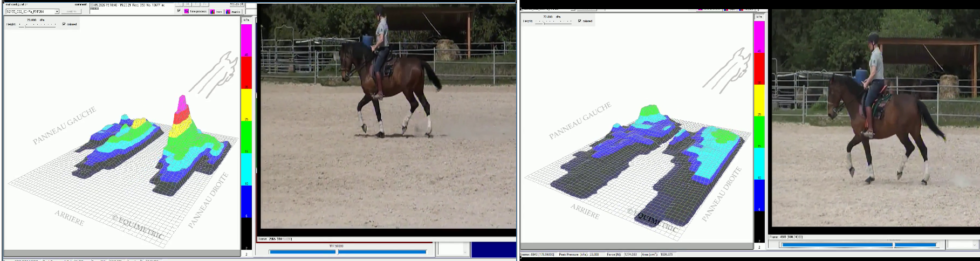
Comparison of pressure maps during the same phase of the trot. On the left, the traditional English saddle used as the reference in the comparison; on the right, the tested Spiritnova configuration. Measurements were synchronized at the same instant of the gait cycle to allow a direct evaluation of pressure distribution on the horse’s back.
A Different Approach to Saddle Design
Spiritnova was developed from the idea that the horse is not a rigid structure, but a living organism in constant motion. For this reason, its design has been focused on promoting a more harmonious distribution of forces and greater freedom of movement.
The measurements obtained do not represent a final destination, but rather an objective confirmation of a design philosophy developed with the horse’s well-being and the quality of interaction between horse and rider at its core.
Data derived from comparative dynamic pressure measurements conducted by an independent professional on the tested Spiritnova configuration and on a traditional reference saddle.